Proud partner

Proud partner
Article


In our previous blog, we briefly touched on the Google Marketing Live event. We gave a brief overview of the various features and possibilities. The central theme of this event was ‘discovery’. In this blog, we’d like to tell you more about two interesting features that fit this theme perfectly: Discovery Ads and Gallery Ads. These two options certainly align with the theme of this annual event. So it’s high time we told you more about the latest developments and possibilities!
Google Discover, a feature that’s actually been around for a while. It was, in fact, introduced last September. However, at the Marketing Live event, it was announced that a new feature is being added: Google Discover will also become available to advertisers. This creates a new form of advertising for your products and services. We’d be happy to tell you more about the options and challenges associated with Discovery Ads.
In fact, Discover is nothing more than a feed displayed on the Google app’s home screen and the Google.com homepage on mobile devices. Users have a great deal of influence here, as they can customise the feed themselves. This allows them to include topics they find relevant. Based on users’ account settings, Google uses information to tailor the content of the feed. Factors taken into account include, for example, app activity and location history. Anyone who thinks this is just a minor development should think again: according to Google, more than 800 million people already use Discover every month.
Discovery Ads not only target potential customers who are actively searching, but also those who are simply exploring. This gives you, as an advertiser, plenty of options for promotion. The variety of channels also increases your reach. Your adverts can be displayed on YouTube, Gmail, ‘ social ’ tabs and, consequently, in the Google Discover feed. What does your advert look like in terms of design? That depends on where it is displayed:
For YouTube and Discover, advertisers can therefore display a single image of their product or service, but multiple images in a swipeable carousel are also an option.
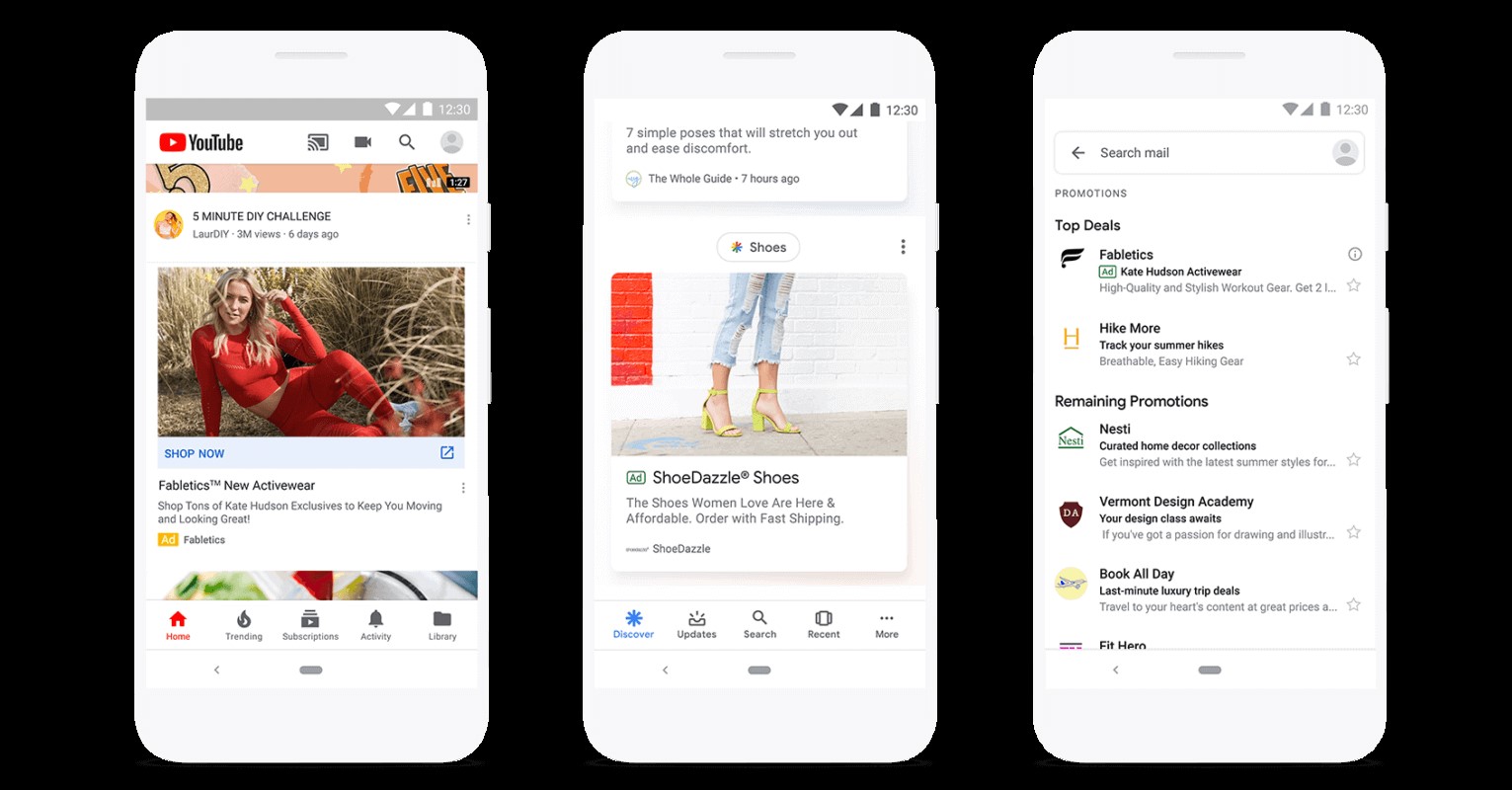
A major advantage of Discovery Ads? The unique targeting options. In fact, this form of advertising can be seen as a combination of audience targeting and search intent. Audience targeting combined with a wider reach and the ability to persuade visitors through image adverts – a unique Ads experience, in other words. The targeting of the adverts is based on Google’s audience segments: interests, in-market and affinity. The benefit: precisely targeted audiences for your adverts.
To launch your Discovery campaign, you’ll need to follow a number of steps:
By filling in the details above, you can begin setting up a Discovery campaign. From this point onwards, Google gets to work using machine learning. It searches for the best combination of headlines, descriptions and images. Whilst Google has already taken a major step forward here with responsive search adverts, it is now sending out new signals. Google is introducing advertisers to the possibilities of the algorithm, with a view to increasing the CTR of your adverts.
The key point to bear in mind is that Discovery ads target feeds rather than search results. The visitor does not type a search query into Google to which you can ‘respond’ with your advert. Instead, you are targeting a feed, where information is shown to someone based on their interests. This is why it is important to adapt your strategy: effective audience targeting is a must. In addition, the creative aspect of the adverts comes to the fore. You need to tell a visual story! In this way, you make use of the audience targeting options and focus on building brand awareness for your brand or organisation.
Imagine this: you’re searching for something on your mobile and the first search result is a headline, a URL and a few images you can swipe through. Wouldn’t that really grab your attention? Wouldn’t you be more likely to linger on that search result? No, we’re not talking about Tinder here, but about Gallery Ads. Just as with Discovery Ads, we’ll explain exactly what they are, how they work and what you can do with them.
We’ve just briefly described the Gallery Ad. It’s a header featuring a visible URL and a number of images that you can swipe through. The images are similar to those on Instagram, for example, where you can include several images in a single post and people can then swipe through them. A picture is worth a thousand words, so here’s an example from Google:

As you can see, the headline is similar to the headlines in other Google Ads formats. You can use three different headlines here (just as with Search). Below the image, you’ll also see text; this is equivalent to description line 1 in Search adverts. Here, you can include a message that complements the image within a limited number of characters (70). You can customise this description for each image! So each image gets its own description. In total, you can add up to eight images to your advert, and there is a minimum of four.
This is where it gets more interesting. Gallery Ads are placed at the top of mobile search results – in the spot where you currently see Search adverts (it is expected that Google’ Shopping s will be displayed above the Gallery Ads). Your advert is therefore prominently displayed, and people can interact with it immediately by swiping. However, this also means that all other results are even less visible. We expect this to have a significant impact on organic search results, which will consequently be displayed a little further down the page.
Initial tests by Google show that these Ads generate 25 per cent more interaction (clicks and swipes) than Search adverts. There is therefore a good chance that people will see a Gallery advert, click on it and then already have the answer to their search query. The rest of the other results are then out of luck. From a neuromarketing perspective, we recognise the real added value of these adverts. We often say that a picture is worth a thousand words, but research has also confirmed this. Our brains process images 60,000 times faster than text. But the difference in how well images are remembered compared to text is also enormous. People remember 80 per cent of the images they see, compared to 20 per cent of a message they read. Bearing in mind that people are constantly bombarded with media messages day in, day out, you naturally want to stand out. So let the image do the work and try to tap into inspiration and experience.
Gallery Ads are therefore advertisements displayed on mobile devices. They consist of a headline, a visible URL and a series of images. Due to their prominent position at the top of search results, the introduction of this type of advertisement will have a significant impact on Search ads, as well as on organic search results. Initial tests have shown that engagement can increase significantly – so there are plenty of reasons to get started.
Gallery Ads and Discovery Ads are two new and impactful ad formats on Google. Both aim to respond more effectively to the intent behind a search query, providing a valuable addition to your customers’ customer journey. Respond to the search query in a visual way and win over your visitors with images. Curious about the advertising options or would you like some more information? The SEA specialists at Traffic Today are here to help. Outsource your adverts now!




Our team is
ready to help you

